Stop the wash with these shoreline rip rap erosion strategies
Your Shoreline Is Losing Ground — Here’s What to Do About It

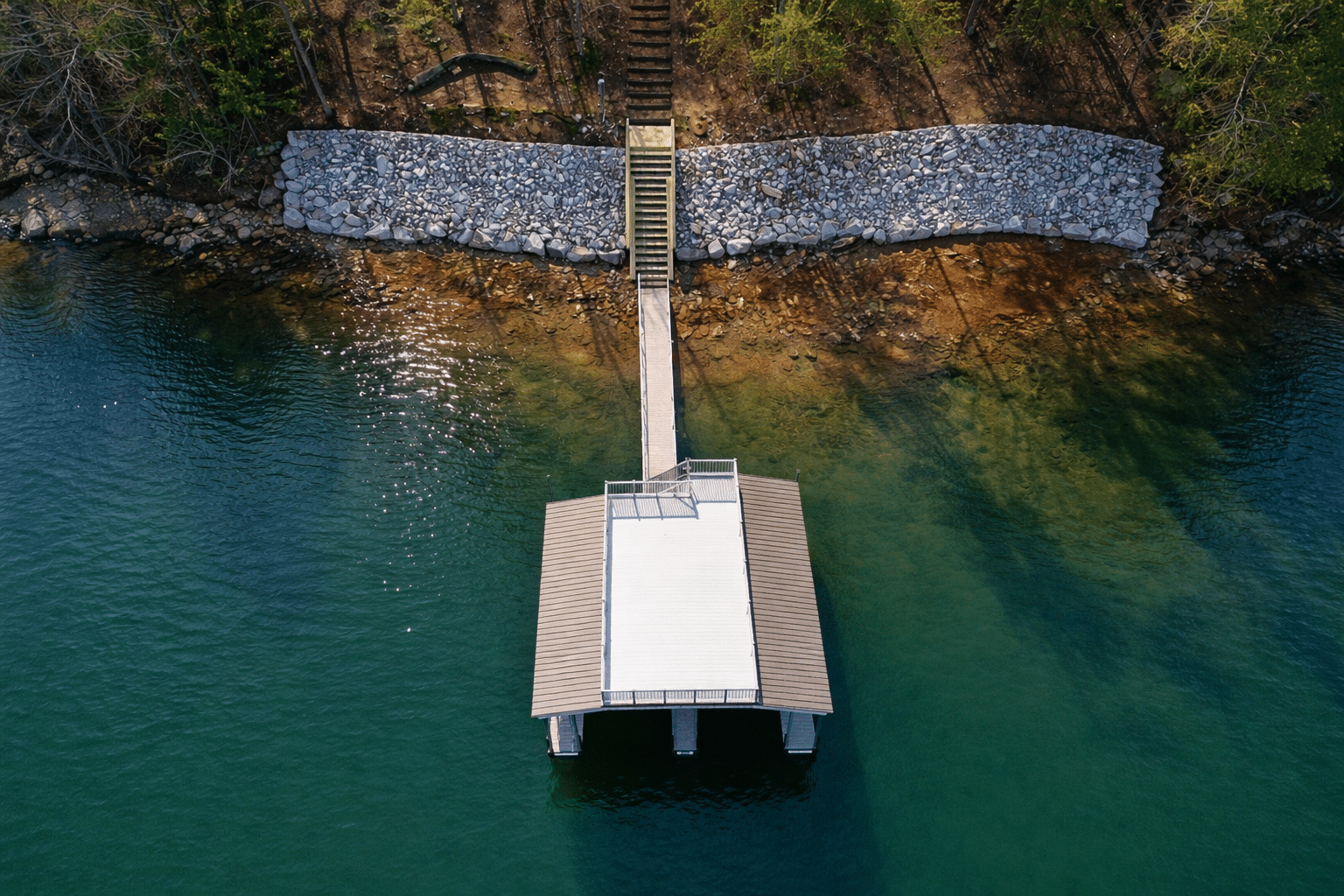
Shoreline rip rap is one of the most effective and widely used methods for stopping lakefront erosion — and if you own property on a Georgia or South Carolina lake, it may be exactly what your waterfront needs.
Quick answer: Rip rap is a layer of angular stones placed along your shoreline to absorb wave energy, hold soil in place, and prevent erosion from boat wakes, water level changes, and weather. A professionally installed rip rap shoreline can last 25 to 75 years or more.
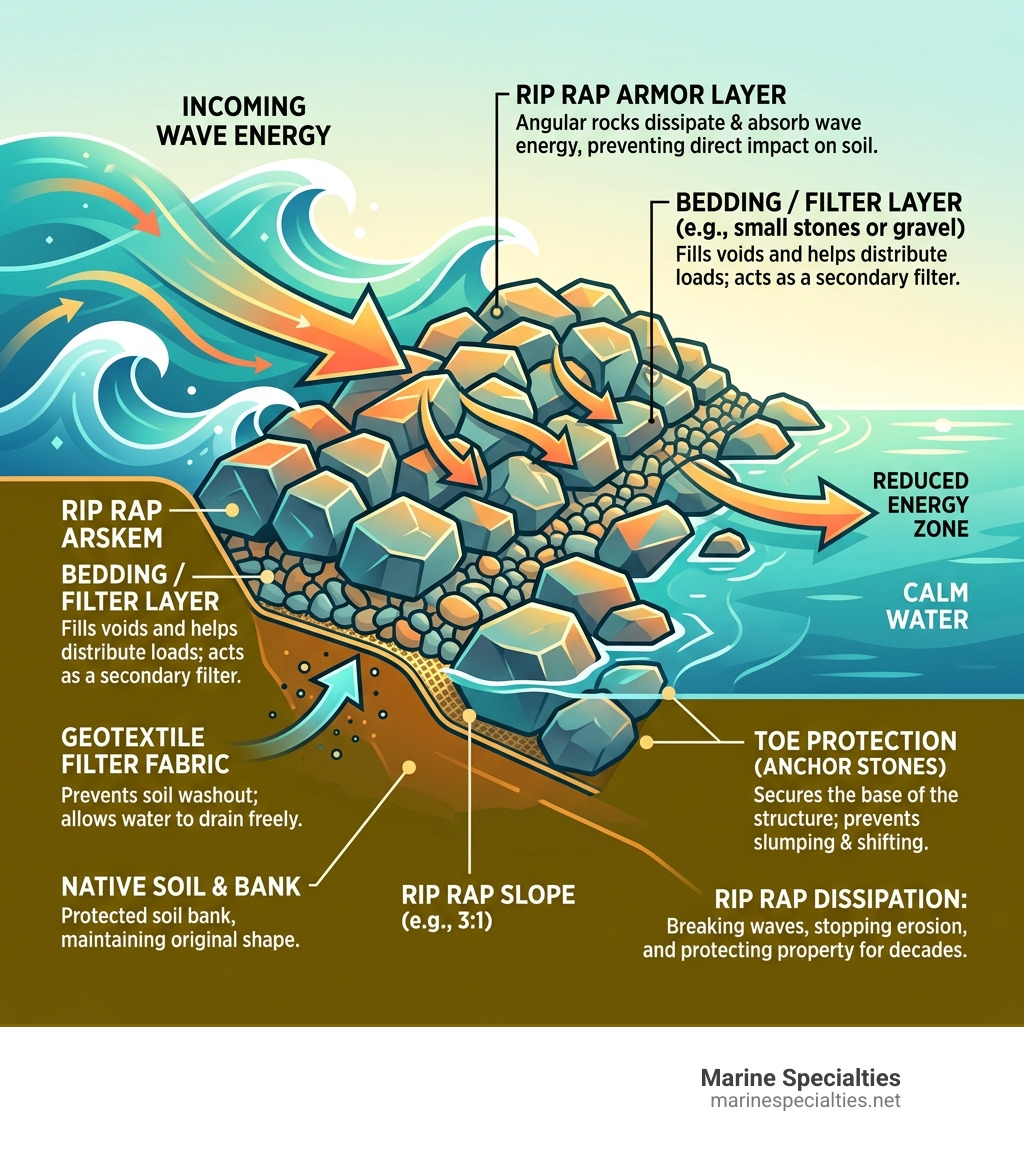
Here’s what makes rip rap work:
- Wave energy dissipation — stones absorb and scatter wave force instead of letting it hit bare soil
- Slope stabilization — a graded 3:1 slope with interlocking rock holds the bank in place
- Filter fabric underlayment — a geotextile layer beneath the rock prevents soil from washing out through the gaps
- Toe protection — larger anchor stones at the waterline stop the base from shifting
Too often, lakefront homeowners reach out for help after significant shoreline damage has already occurred — after the bank has receded, the dock has started to shift, or chunks of land have disappeared into the water. The good news is that rip rap, when installed correctly, stops that process and protects your investment for decades.
At Marine Specialties, we work with lakefront property owners across Lake Lanier including Hall county, Forsyth County, Dawson County, Gwinnett County, and Lumpkin County to design and install rip rap systems built for the specific conditions of your lake — from wave energy and slope grade to soil type and water level fluctuation.
What is Shoreline Rip Rap and How Does It Work?
If you’ve spent any time on Lake Lanier or Lake Keowee, you’ve likely seen those layers of rugged, chunky stones lining the water’s edge. That is shoreline rip rap. In technical circles, it’s often referred to as “rock armor” or “shot rock,” and it serves as the first line of defense for your property.
Essentially, What is riprap? It is a human-placed layer of durable, various-sized rocks designed to protect soil from the constant “hydraulic impact” of moving water. When a boat wake or a wind-driven wave slams into a vertical dirt bank, the water carries the soil away with it. Rip rap changes that dynamic entirely.
Because the rocks are placed loosely and have gaps between them, they trap the water and force it to weave through a maze of stone. This process drains the wave’s energy before it ever touches the dirt. Beyond just stopping waves, rip rap provides essential slope stabilization. By regrading a steep, failing bank into a more gradual incline and “armoring” it with stone, we prevent gravity from pulling your backyard into the lake. You can learn more about the mechanics in our guide on How to Use Riprap for Erosion Control.
Choosing the Right Stone for Your Shoreline Rip Rap
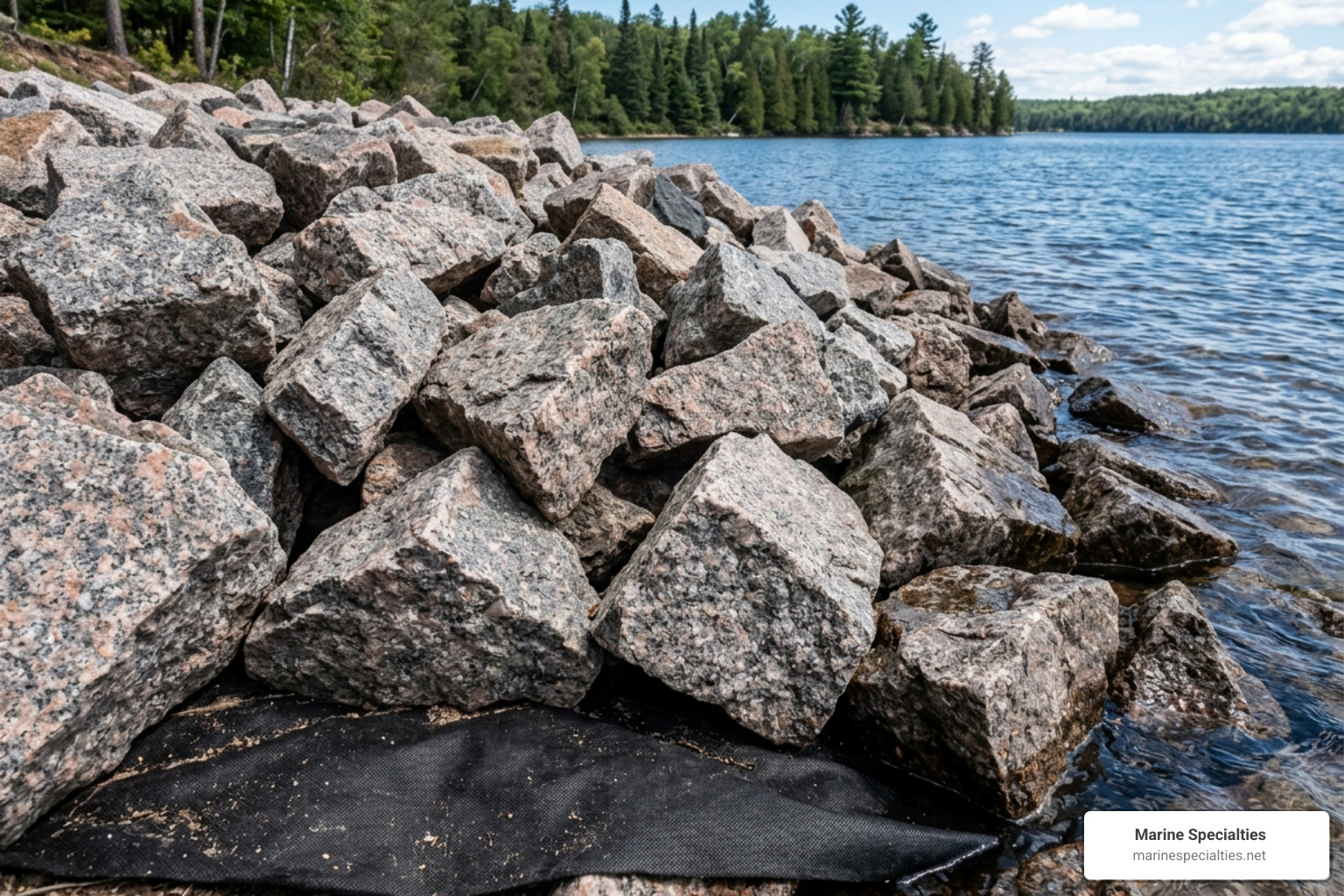
Not all rocks are created equal. If you use smooth, round river stones, they’ll simply roll over each other like marbles when a heavy wave hits. For a truly stable shoreline rip rap installation, we prioritize angular rocks.
- Granite: This is the gold standard for Lake Lanier. It is incredibly hard, heavy, and features sharp, jagged edges that allow the stones to “lock” together.
- Interlocking Matrix: Think of it like a jigsaw puzzle. When angular stones are placed together, they wedge into one another, creating a dense, heavy blanket that resists movement even during major storms.
- Stone Gradation (D50): We don’t just dump one size of rock. We use a “well-graded” mixture. The “D50” refers to the median stone size. By mixing smaller stones with larger ones, the small rocks fill the voids between the big ones, creating a tighter seal that prevents the underlying soil from being sucked out. Typical rock sizes for our regional lakes range from 6 to 12 inches for most residential shorelines, though high-energy areas may require larger “surge” stone.
The Role of Geotextile Fabric in Erosion Defense
If the rock is the “armor,” then the geotextile fabric is the “backbone.” One of the most common reasons DIY or “budget” rip rap jobs fail is because the installer skipped the filter fabric or used a cheap, thin version.
Without fabric, the water moving between the rocks eventually reaches the soil. Over time, it creates tiny tunnels under the rocks, eventually causing the stones to sink into the mud—a process called “subsidence.”
We use heavy-duty, non-woven needle-punch filter fabric (often 8-oz or 12-oz thickness). This fabric acts as a high-tech sieve: it allows water to pass through freely so pressure doesn’t build up, but it keeps even the smallest soil particles in place. This separation is vital for preventing washouts. If you want to dive deeper into why this layer is so critical, check out our article on How to Safeguard Your Property with Rip Rap.
Professional Installation Best Practices
Installing shoreline rip rap across is much more than just throwing rocks at a bank. It requires a strategic, engineered approach to ensure the installation doesn’t just look good on day one, but stays put for fifty years.
The process begins with a thorough site assessment. We look at the “fetch” (the distance wind can travel over water to create waves), the depth of the water at the bank, and the existing slope.
- Grading the Slope: A bank that is too steep will eventually fail, rocks and all. We aim for a 3:1 slope (three feet of horizontal distance for every one foot of vertical rise). This angle is the “sweet spot” for stability and wave dissipation.
- Determining the OHWL: We must account for the Ordinary High Water Level (OHWL). On lakes like Lanier or Hartwell, water levels fluctuate significantly. We ensure the rip rap extends high enough to protect the bank during flood stages and deep enough to stay covered during droughts.
- The Toe Trench: This is the most important structural element. We dig a trench at the base of the slope, below the waterline, and fill it with our largest “anchor” stones. This “toe” prevents the rest of the rock wall from sliding down into the lakebed.
- Hand-Placement: While heavy machinery does the heavy lifting, the final layer of our Rip Rap Shoreline Installation often involves hand-tuning. This ensures the stones are tightly interlocked and the surface is as smooth and aesthetically pleasing as possible.
Common Mistakes in Shoreline Rip Rap Installation
We’ve spent 35+ years on the water, and we’ve seen plenty of “oops” moments from less experienced contractors. Here are the big ones to avoid:
- Steep Slopes: Trying to save space by keeping a 1:1 slope. Gravity always wins eventually, and the rocks will eventually slump into the water.
- Rounded Stones: Using “river rock” or smooth fieldstone for the primary armor. Without those jagged edges to lock together, the stones shift every time a boat passes.
- Skipping Fabric: As mentioned before, this leads to the “disappearing rock” act where your rip rap slowly sinks into the lake bottom.
- Poor Anchoring: If you don’t dig a proper toe trench, the entire installation can be undercut by waves, causing the whole structure to “unzip” from the bottom up.
- Ice-Jacking: In our North Georgia and South Carolina winters, ice can form and expand. A 3:1 slope allows ice to slide up the rocks rather than pushing into them, which prevents the stones from being dislodged. You can read more about these pitfalls in our guide to Shoreline Protection.
Permitting and Environmental Regulations
You can’t just back a dump truck up to the lake and start tipping. Shorelines are highly regulated environments. Depending on your location—whether it’s Lake Lanier or Lake Keowee—you may need approval from the US Army Corps of Engineers or state-level DNR offices.
Most regulations focus on ensuring that your shoreline rip rap doesn’t encroach too far into the water or destroy critical aquatic habitats. For example, many regions require that rip rap follow the natural shoreline alignment and use only clean, natural stone. At Marine Specialties, we handle the headache of permitting for you, ensuring your project meets all local zoning and environmental standards.
Why Rip Rap is the Superior Choice for Shoreline Protection
When lake homeowners look at erosion control, they often compare rip rap to seawalls (bulkheads). While seawalls have their place, rip rap is frequently the better choice for residential lakefronts for several reasons.
Effective Wave Energy Dissipation
The biggest problem with seawalls is “wave reflection.” When a wave hits a flat, vertical concrete or steel wall, the energy isn’t absorbed—it’s reflected back out into the lake. This creates “scour zones” at the base of the wall, where the reflected energy churns up the lakebed and eventually undermines the wall itself.
Shoreline rip rap, on the other hand, is a “soft” engineering solution. It absorbs and scatters that energy. This protects not only your bank but also the lakebed and your neighbors’ shorelines. By preventing that underwater turbulence, you keep your shoreline stable for the long haul.
Rip Rap’s Environmental and Aesthetic Advantages
From an ecological standpoint, rip rap is a winner. Unlike a sterile concrete wall, the nooks and crannies between rip rap stones provide a home for small fish, invertebrates, and beneficial algae. This supports the local food chain and helps maintain water quality.
Additionally, rip rap doesn’t cause “thermal pollution.” Concrete walls can bake in the sun and transfer that heat to the water, which can be harmful to local aquatic life. Stone stays cooler and allows for the integration of native plantings. Many homeowners choose to plant native grasses or shrubs just above the rip rap line, creating a beautiful, natural transition from the lawn to the water. It’s a look that blends seamlessly with the Georgia and South Carolina landscape.
Maintenance and Longevity of Your Armored Shoreline
One of the best things about a professionally installed shoreline rip rap system is its lifespan. While a wooden seawall might rot in 15 years, a well-built rock shoreline can easily last 25 to 75 years. However, “low maintenance” doesn’t mean “no maintenance.”
To get the most out of your investment, we recommend:
- Annual Inspections: Every spring, walk your shoreline. Look for any areas where stones might have shifted or where the fabric might be exposed.
- Post-Storm Checks: After a major storm or a season of unusually high water, check the “toe” of the installation to ensure no stones have been pulled out into the lake.
- Debris Removal: Occasionally, logs or trash can get wedged in the rocks. Removing these prevents them from acting as levers that could dislodge your stones during the next big wave.
- Weed Control: While some vegetation is good, you don’t want large trees or woody brush growing through the rip rap, as their roots can eventually push the stones apart.
Frequently Asked Questions about Shoreline Rip Rap
How much does shoreline rip rap cost per linear foot?
Pricing for shoreline rip rap can vary based on several factors, including the height of the bank, the type of stone used, and how easy it is to get heavy machinery to your water’s edge. On average, a standard installation might range from $20 to $35 per linear foot for the materials and labor for a basic setup. However, for more complex projects involving steep grading or specialized “hand-placing,” costs can be higher. It’s important to remember that while the upfront cost is higher than a quick fix, the 50-year lifespan makes it the most cost-effective solution over time.
Is rip rap better for wildlife than a seawall?
Absolutely. Seawalls create a “dead zone” where the water meets the land. Rip rap creates a “living shoreline.” The crevices between the rocks provide essential refuge for small fish and invertebrates. Furthermore, rip rap helps filter organic matter from the water, which can actually improve the local water quality around your dock.
Can I add steps or a path to my rip rap shoreline?
Yes! In fact, we recommend it. Navigating a pile of jagged rocks can be tricky (and hard on the ankles). We often integrate “flat-stone” steps or pathway steps directly into the rip rap design. This gives you safe, easy access to your dock while maintaining the integrity of the erosion protection. We can even add safety railings that blend into the natural aesthetic.
Conclusion
Your lakefront property is a major investment, and the shoreline is its most vulnerable point. Don’t wait until you’ve lost feet of backyard to the waves. Whether you are on Lake Lanier, Lake Oconee, or Lake Hartwell, a professional shoreline rip rap installation is the most reliable way to stop the wash and keep your land where it belongs.
At Marine Specialties, we’ve spent over 35 years mastering the art and science of marine construction. From Gainesville, Cumming, Flowery Branch, Buford and beyond, our licensed and insured teams are ready to help you safeguard your property with custom designs and expert installation.
Protect your investment with a professional rip rap shoreline installation — contact us today for a complimentary design consultation and let’s build a shoreline that’s tougher than the elements.