Lake Lanier Rip Rap & Shoreline Steps: 52 Feet of Granite Erosion Control in Cumming, GA
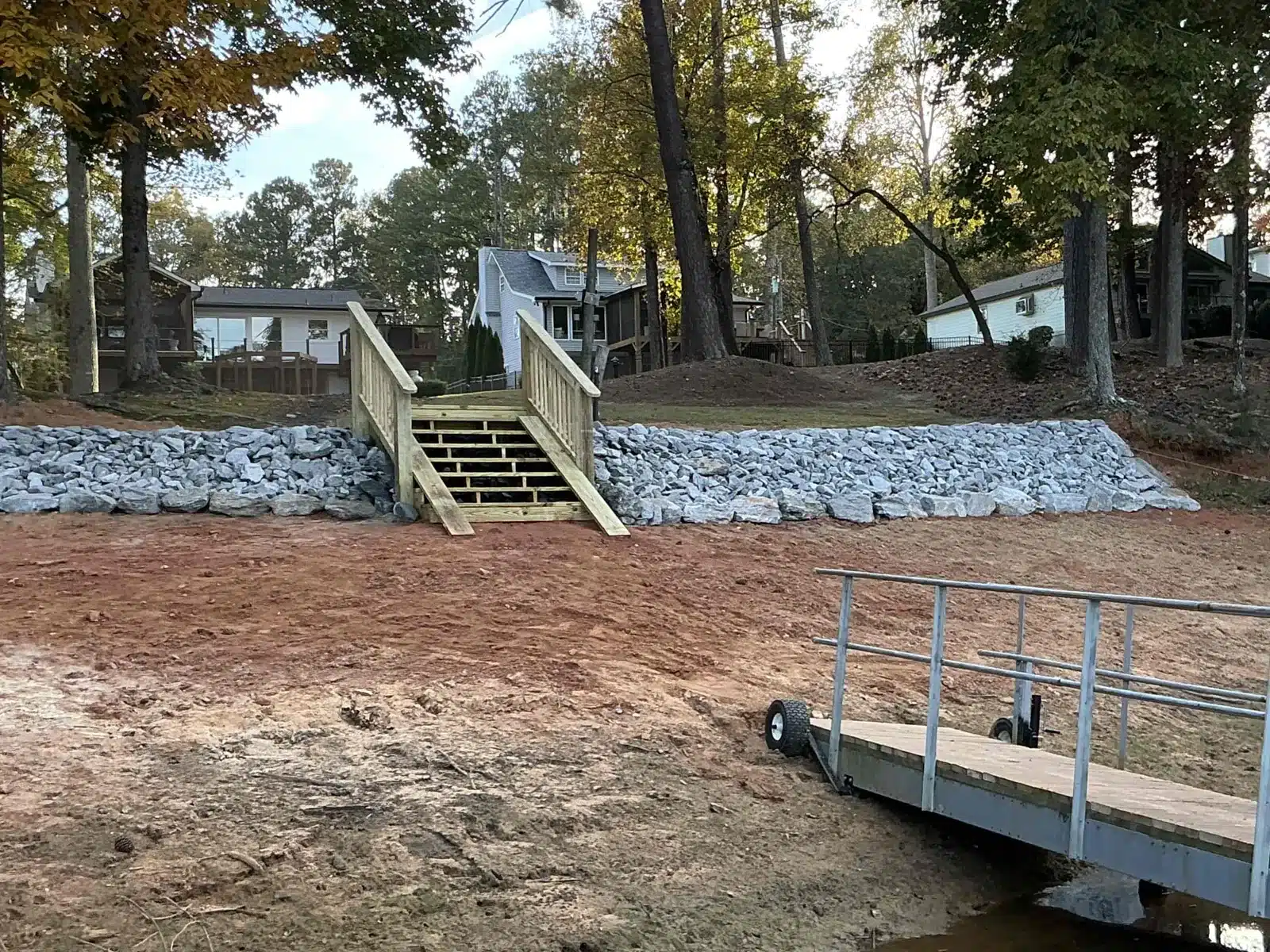
A Cumming homeowner on Lake Lanier had a raw clay bank washing into the lake and no safe way down to the dock. We armored it with 20 tons of Type I and Type III granite and built new shoreline steps right over the stone.
The short version
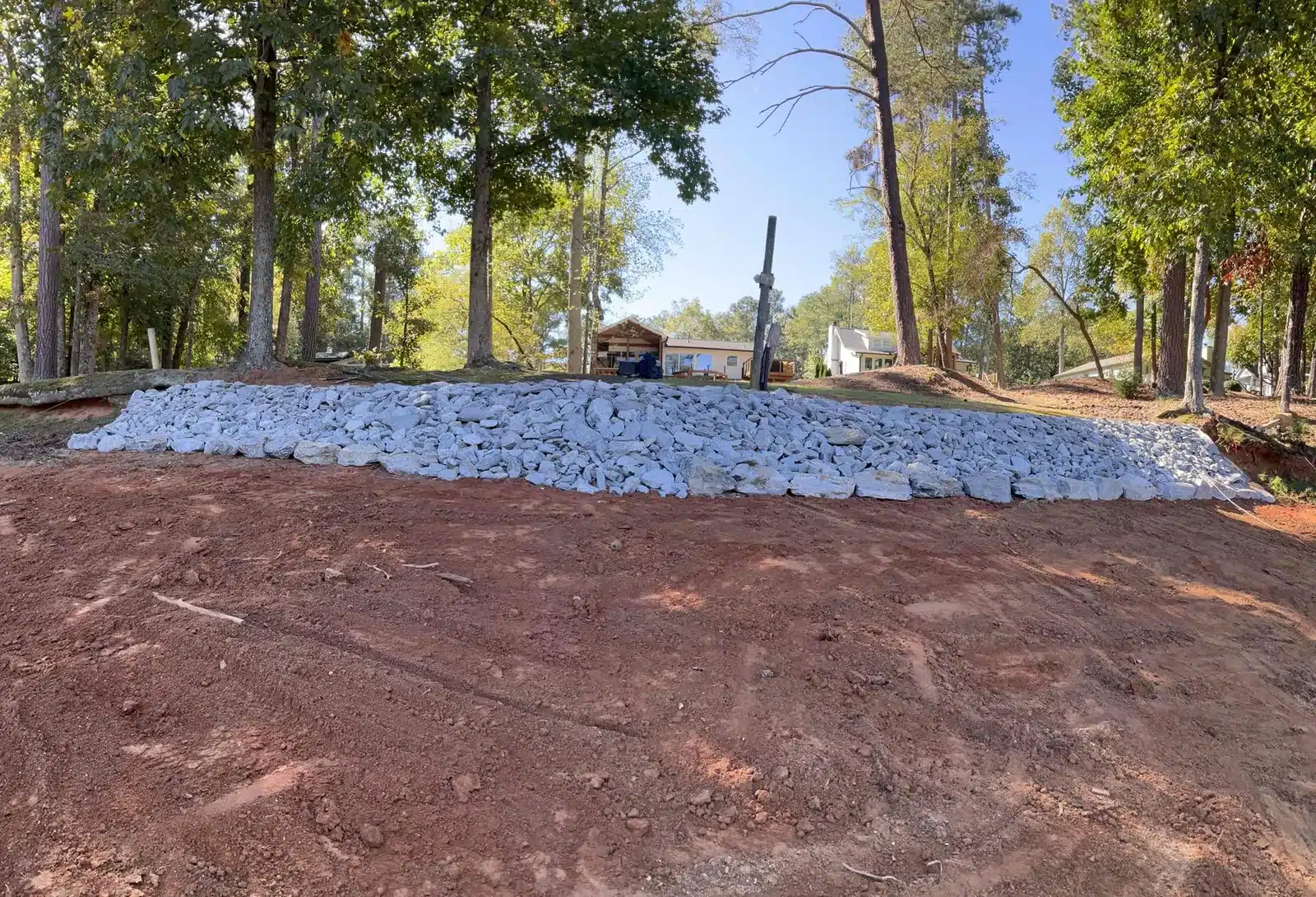
Marine Specialties installed 52 linear feet of granite rip rap erosion control on a Lake Lanier shoreline in Cumming, Georgia (30041). The crew graded the eroding red-clay bank, set a toe of large Type I granite, covered the slope with Type III granite, and used 20 tons of stone in total, about 770 pounds per foot of shoreline. We then built pressure-treated shoreline steps with handrails over the rip rap so the homeowner has a safe path from the yard to the dock walkway at any lake level. Marine Specialties is a licensed and insured marine contractor based in Gainesville, GA. We handle the U.S. Army Corps of Engineers permitting and install rip rap across Lake Lanier, including Cumming, Gainesville, Buford and Flowery Branch.
Bank Grading, Granite Rip Rap & Shoreline Steps
This project took the bank from bare clay to finished stone, with stairs down to the dock.
- Graded and shaped the eroded bank so stone sits on a stable slope
- Set large Type I granite along the toe as the base course
- Covered the slope with Type III granite to lock the bank in place
- 52 feet of shoreline protected with 20 tons of granite
- Built framed shoreline steps over the rip rap, centered on the dock
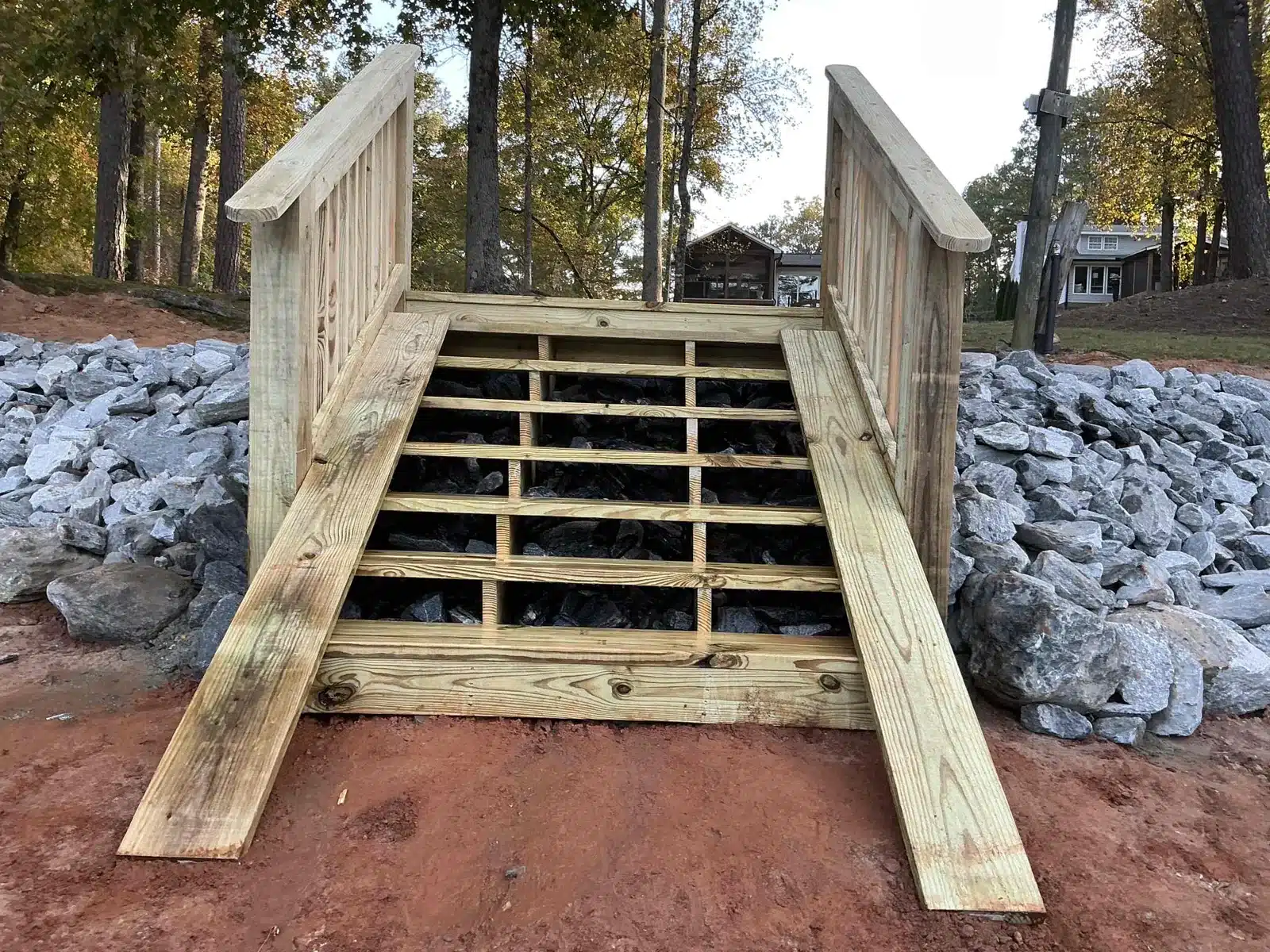
- Stone-filled step cribs that tie the stairs into the rip rap wall
- Handrails on both sides plus a top landing at yard level
- Rise-and-run boards so the dock walkway can land on the steps
- Work staged from our barge on the lake side
- Final cleanup of the lakebed and work area
The Challenge
This lot sits on a Lake Lanier cove in Cumming, where boat wakes and wind-driven waves reach the bank all season. With nothing armoring it, the shoreline was losing ground.
- A raw clay bank. Waves had cut the shoreline into a steep red-clay face. Every storm and every wake carried more soil into the lake.
- Exposed roots at the top of the bank. As the face eroded, roots of the shoreline trees were left hanging, a sign the bank was retreating toward the yard.
- No safe path to the dock. The family had to climb down loose, uneven clay to reach the dock walkway, and the route got worse after every rain.
- Corps-managed shoreline. Like most of Lake Lanier, the work area is U.S. Army Corps of Engineers property, so the rip rap and steps had to follow Corps shoreline rules.
The homeowner wanted two things: stop the erosion for good, and make getting to the boat easy again.
What 52 Feet of Rip Rap Takes
Tonnage per foot calculated from this project’s totals.
Our Solution
Here’s how we installed rip rap and shoreline steps on this Cumming lot, in order.
- Site walk and Corps approvalOn Lake Lanier, rip rap (“shoreline protection”) and steps are both items the Corps of Engineers licenses, and approval comes before any work starts. Marine Specialties handles the permitting from start to finish, so the homeowner never has to deal with the paperwork.
- Grade the bankA mini excavator working from the exposed lakebed knocked down the vertical clay face and shaped an even slope. Stone dumped on an ungraded bank slides into the lake within a few seasons, so grading is our standard step, not an upgrade.
- Set the Type I toeThe largest granite went in first along the bottom of the slope. This base course is what keeps the whole revetment from creeping downhill when waves hit it.
- Armor the slope with Type IIISmaller Type III granite filled in above the toe and tied into the larger stone, covering the clay from the waterline to the top of the bank.
- Build the steps over the stoneWe framed pressure-treated stairs over the rip rap, filled the step cribs with stone so they lock into the wall, and added handrails, a top landing, and rise-and-run boards for the dock walkway.
- Clean upWe cleaned up the work area and hauled away scraps and debris, so the shoreline looks like a finished landscape.
Learn more about our rip rap shoreline installation service.
Type I vs. Type III Rip Rap: Why We Used Both
In Georgia, rip rap is sold by Georgia Department of Transportation (GDOT) size grades. Type I is the larger, heavier stone. Type III is a smaller, lighter grade. Most Lake Lanier shorelines get the best results from a combination of the two.
| Type I granite | Type III granite | |
|---|---|---|
| Typical stone weight | About 125–700 lb per stone | About 15–165 lb per stone |
| GDOT design size | Median stone size (d50) up to 1.2 ft | Median stone size (d50) up to 0.7 ft |
| Where it goes | The toe and base of the slope, where wave energy is highest | The slope above the toe, filling gaps and covering bare soil |
| What it does here | Anchors the revetment so it can’t slide into the lake | Locks into the Type I base and gives a tight, finished surface |
Stone weights from Martin Marietta’s Georgia rip rap specifications. Design sizes from GDOT construction standard D-55. Exact stone sizes vary by quarry and load.
Shoreline Steps Built Over the Rip Rap
Rip rap protects the bank, but loose stone is hard to walk on. Shoreline steps give the family a safe path to the water without disturbing the stone.
- Built into the wall. The step cribs are filled with granite, so the stairs sit inside the rip rap instead of on top of loose soil.
- Handrails on both sides. Balustrade-style rails from the top landing to the bottom tread for a steady climb on a steep bank.
- Lined up with the dock. The stairs land right where the dock walkway meets the shore. Long rise-and-run boards give the walkway a place to roll when the dock is moved in or out as Lake Lanier rises and falls.
- Top landing at yard level. A pressure-treated landing at the top of the bank connects the stairs to the lawn.
See all of our shoreline and timber step options, or ask about moving your dock as lake levels change.
Before & After
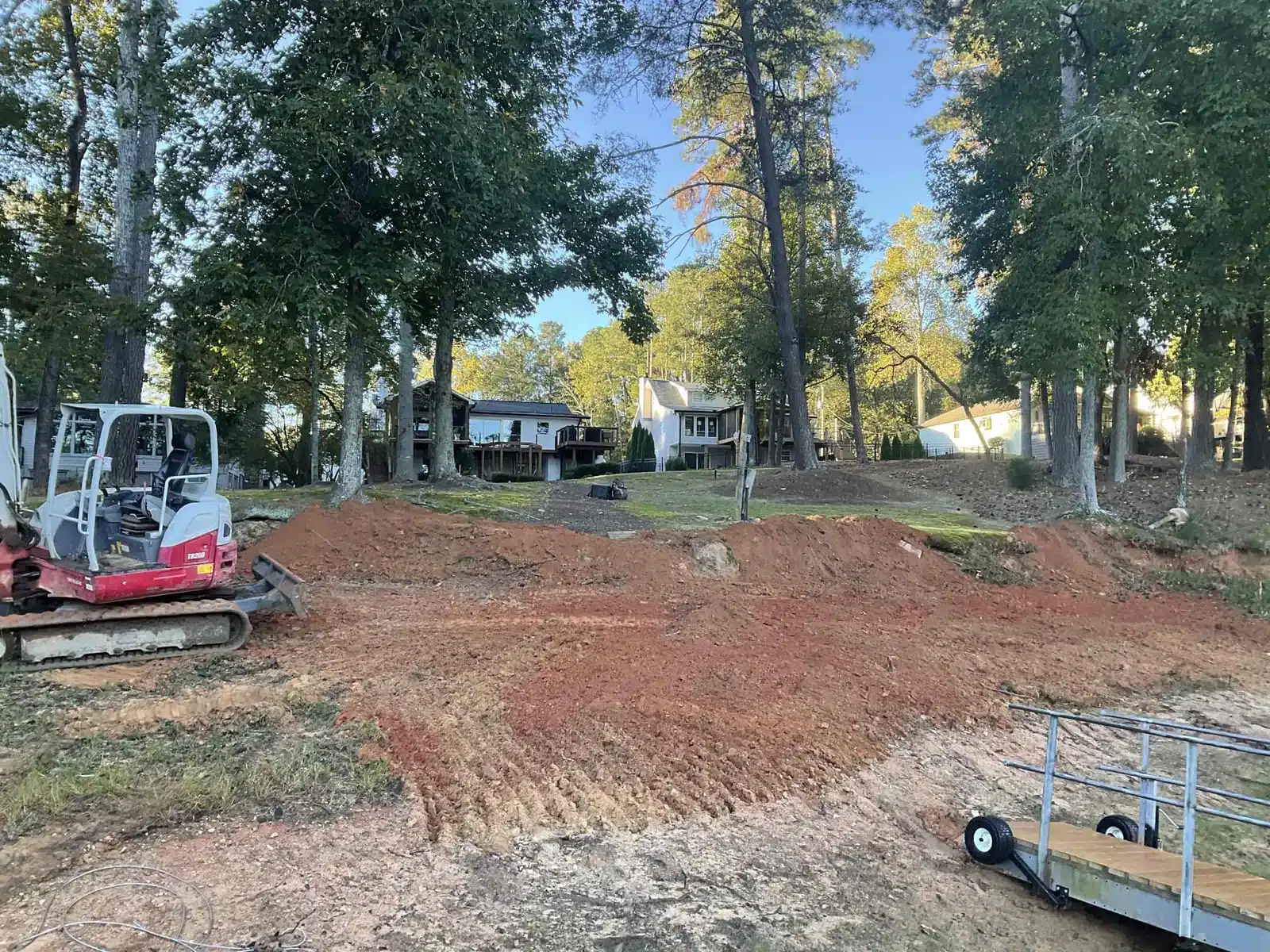 BeforeAfter
From Bare Clay to Finished Stone
Tap any photo to enlarge.
The Result
- Erosion stopped at the waterline. Granite now takes the hit from boat wakes and waves instead of bare clay.
- A safe walk to the dock. Handrailed steps replace the scramble down a muddy bank, and they line up with the dock walkway.
- Ready for changing lake levels. The rip rap covers the bank from the toe up, and the walkway can land on the steps as the dock is moved.
- A finished look. Clean granite and new pressure-treated lumber read as landscaping, not construction.
Every foot of bank that stays put is waterfront that stays on the deed.
Rip Rap & Steps Customers
★★★★★“These guys know exactly what they’re doing and made sure I was happy prior to them leaving the property.”
Rick W. · Rip rap & stairs customer
★★★★★“Marine Specialties did an AMAZING job on our riprap and new staircase for our dock ramp.”
Keith P. · Rip rap & staircase customer
Rip Rap Erosion Control in Cumming, Gainesville & Buford
Marine Specialties has worked on Lake Lanier since 1988. Our North Georgia office is on Browns Bridge Road in Gainesville, and our crews and barges cover every side of the lake.
Cumming, GA (Forsyth County)
This project is in the 30041 ZIP code on Lanier’s Forsyth County shore. We’ve also protected other Cumming shorelines with granite rip rap and Type I base stone.
Gainesville, GA (Hall County)
Our home base. On one Gainesville point we installed 332 feet of granite rip rap with 400 tons of stone, plus two sets of stone steps, in 13 days.
Buford, GA
Near Buford Dam and the Corps’ Lake Lanier management office, where shoreline permits are processed. We’ve built rip rap and custom steps for Buford homeowners too.
We also serve Flowery Branch, Oakwood, Dawsonville and the rest of the Lake Lanier shoreline. See all service areas.
Lake Lanier Rip Rap FAQ
How much rip rap do I need for my Lake Lanier shoreline?
It depends on the length of the shoreline, the height and steepness of the bank, and the stone grades used. On this Cumming project, 52 feet of shoreline took 20 tons of Type I and Type III granite, about 0.38 tons (770 pounds) per linear foot. Taller banks need more stone per foot. We measure your bank during a free site visit and quote tonnage before work starts.
What is the difference between Type I and Type III rip rap?
Type I and Type III are Georgia DOT size grades. Type I is the larger stone, roughly 125 to 700 pounds each, and goes at the toe of the bank where waves hit hardest. Type III is smaller, roughly 15 to 165 pounds each, and covers the slope above. Using both gives you a heavy base that won’t slide and a tight surface that keeps soil from washing out.
Do I need a permit for rip rap or shoreline steps on Lake Lanier?
Yes, in most cases. Lake Lanier’s shoreline is managed by the U.S. Army Corps of Engineers, and both shoreline protection (rip rap) and steps are items the Corps licenses. A permit must be issued before work begins on Corps property. Marine Specialties handles the permitting for you, from the application to Corps approval. Read the Corps’ Lake Lanier shoreline management guidance.
How much does rip rap cost on Lake Lanier?
Cost depends mainly on shoreline length, tons of stone, bank grading, site access (truck, yard or barge), and extras like steps or tree removal. Because every bank is different, we price each job after a site visit. Request a free rip rap estimate or call (770) 531-7735.
When is the best time to install rip rap on Lake Lanier?
We install rip rap year-round. Low water, like the conditions on this job, exposes the toe of the bank so the base stone can be set below the normal waterline. Because shoreline work needs a Corps permit, it pays to call early. We handle the permitting while we plan your project.
Can shoreline steps be built over rip rap?
Yes. On this project we framed pressure-treated steps over the rip rap and filled the step cribs with granite so the stairs lock into the wall. Handrails, a top landing, and rise-and-run boards for the dock walkway finish the job.
Do you install rip rap in Cumming, Gainesville and Buford?
Yes. Marine Specialties installs granite rip rap and shoreline steps all around Lake Lanier, including Cumming, Gainesville, Buford, Flowery Branch, Oakwood and Dawsonville. Our North Georgia office is at 4105 Browns Bridge Rd, Gainesville, GA 30504.
Get a Free Rip Rap Estimate on Lake Lanier
We’ll walk your shoreline, measure the bank, and price rip rap, steps, or both. Most estimate requests hear back the same business day.
- Marine construction since 1988
- Licensed & insured
- We handle all permitting
- Free design consultations
Planning your own project? Read our complete guide to rip rap erosion control on Lake Lanier, or see our 155-foot residential rip rap case study.